
~post by Raul M. Chapa
I was completely bummed when I read the news last week; one of my favorite writers announced that he has an incurable form of cancer and has only a few months to live. Iain M. Banks’s science fiction books have lived on my shelves since I was young. His other novels written as Iain Banks have also lived on my shelves, in loving homage to a writer who has given me and the world so much. I am still in a state of shock, but perhaps now is the time to say a few words about how important his fiction is to me.
I came across Iain M. Banks’ science fiction right out of high school. Consider Phlebas was my summer read that year, and I remember that I read it over a weekend and told myself, “Wow, that was one hell of a fun book!” You have to understand that this was in a time when the Internet was in its infancy (1987 to be exact!), so I did not have Wikipedia or even Google to find out more about him or what he had written; there was no social media to inquire if anyone liked what he had written, nor any references to his other works other than the list of titles at the beginning of the book.

So I began with that. The next book of his I came across was The Wasp Factory, and I happened to find it in a small bookstore in, of all places, Weslaco (remember, no Internet – living in the Magic Valley in South Texas, I was really lucky to find anything). The owner was familiar with Banks, and it was he who wholeheartedly suggested I keep in mind that Iain M. Banks and Iain Banks were one and the same person. After reading Wasp Factory, I found that hard to believe. I mean, here was a writer who had totally blown me away with his science fiction and now he’s writing books about deep psychological trauma and murder, tackling questions of identity, and writing ripping yarns about all that teenage angst I felt at the time (for those of you keeping score, Wasp Factory was Bank’s first book; Consider Phlebas was his first science-fiction book).

The surprises kept coming whenever I found a title by him; it was like he was writing a different book every time and here is the rub: before I read Banks, I was comforted by writers who were very good at doing the same thing over and over. I loved the Lovecraft school of writers; I loved the Sapir and Murphy Destroyer books as well as Pendleton’s Executioner. I loved those writers who are part of the literary canon: from Dostoevesky and Hesse to Verne and Wells. My point being that whenever I read someone like them, I kinda knew what to expect – in fact, I could very well say that it was what I wanted.
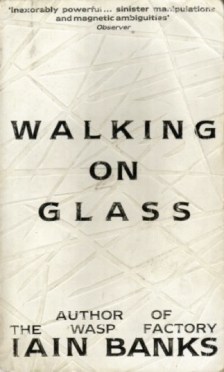
Banks’s writing changed that for me, and I am very thankful for that. When I read The Crow Road, one of the best coming of age books in my opinion, I was reminded that all families have similar upbringings complete with strange uncles and dark secrets. At the same time, Use of Weapons reminded me that our past is what makes us what we are: we cannot hide our true nature from ourselves because we fear it. There is the darkly poetic Walking on Glass that takes place in a world much like our own (if by chance you run across a copy, grab it – then give it to someone you love) except for the protagonists.
I find myself comparing other authors to Banks on various levels, and this has been his greatest gift to me as his loyal and humble reader. It’s not that this or that book is good enough for a prize or for anything like that – what matters to me is if Iain Banks could have written it. More often than not, I find that not only could he have written it, he probably would have done a better and more entertaining job.

 BookPeople
Reblogged this on The Rag Tree and commented:
a heartfelt tribute… RT
Sad news. Wonderful tribute.
A brilliant author, and a fine connoisseur of whiskeys
Reblogged this on My Day Out With An Angel.
Excellent tribute. Will start reading his books. Thanks